
Epigrams
Marot first published his poems as epigrams in 1538, in two books (section of his Oeuvres, Gryphius, Lyon). Some had appeared earlier (e.g. as dizains in L'Adolescence clémentine). In his scholarly edition, Defaux grouped all remaining epigrammatic poems together and labelled them Book III of the Epigrams. Posthumously, in 1547, Marot's epigrams in imitation of Martial were published by the Marnef brothers in Poitiers. Defaux grouped these epigrams in Book IV — in it Defaux also included a number of 'spurious' epigrams (first published only in 1550, by Groulleau). In my opinion, Defaux failed as an editor in this respect. But since his edition has become 'standard' I follow Defaux's ordering principle and numbering.
Below the French text I offer English translations, 'as they are' — that is, with no guarantee of correctness. Marot is NOT simple, and in the epigrams deliberately so: a great deal of sous-entendu, intricate wordplay. My French is not good enough to catch it all.
Special page with numerous Dutch translations. Dutch translations on this page are mine.
- De Frère Thibault – Frère Thibault, sejourné gros et gras
- De soi-même – Plus ne suis ce que j'ai été (plus two reponses on the same subject) – three lovely poems about getting of age
- A Madame de Ferrare – Me souvenant de tes bontés/grâces divines
- De Jehan Jehan – Tu as tout seul, Jehan..
- De Pauline – Pauline est riche et me veult bien
- A Madame de la Barme – Adieu ce bel oeil tant humain
- A une Damoyselle malade – Ma Mignonne (opens a new window)
- Estreines à Anne – Ce nouvel an pour Estreines vous donne mon coeur
- A une Dame agée, et prudente – Ne pensez pointe que ne soyez aimable
- D'Anne (qui luy jecta de neige)
- D'Anne (jouant de l'espinette)
- D'Albert joueur du luz (=luth) de Roy
- D'Une dame désirant voir Marot – Ains que me voir en lisant mes écrits
- De Marguerite d'Alençon, sa Soeur d'Alliance
- De sa Dame et de soymesme – Des que m'Amye est ung jour
- Du Ris de Madame d'Allebret – Elle a tresbien cette gorge d'Albastre
- D'Oui, et Nenny – D'un doux nenny
- De soi-même – Marot, voici (si tu le veux savoir) – Martialis
- Du beau tétin – Tétin refait, plus blanc qu'un oeuf
- Du laid tétin – Tétin qui n'as rien que la peau
The poems (epigrams)
De Frère Thibault
This is one of the most famous epigrams Marot ever wrote. Not only because of the bawdy text (we
often label vulgar and rude, but in the 16th century was appreciated by all layers of society), but
also because it was put to music almost immediately by Marot's friend and colleague, one of the court
composers Pierre Certon (Quart livre de chansons à 4 – published by Pierre Attaingnant, 1540
(Fo. II)). NB: Certon was a cleric himself. Noteworthy: Roland de Lassus also put this epigram (using
Certon's melody) to music and composed a 'holy Mass' based on the musical theme of the chanson (1570,
'Missa supre Frère Thibault'). The "Kyrie" is the most recognisable part of it: Certon's chanson
melody is present, almost note by note.
[Epigr I,47]
Frère Thibault, sejourné gros et gras,
Tirait de nuit une garce en chemise
Par le treillis de sa chambre: où le bras
Elle passa, puis la tête y a mise,
puis tout le sein, mais elle fut bien prise,
Car son fessier y passer ne peut onc :
"Par la morbieu, ce dit le moine adonc,
Il ne m'en chaut de bras, tétin ne tête;
Passez le cul, ou vous retirez donc,
Je ne saurois sans lui te faire fête".[One night, brother Thibald, fat and lazy, / pulled in a whore dressed only in a shirt / through the lattice of his cell: her arm / went in well; so did her head and / all of her bosom, but she got stuck, / her bottom did not pass, how hard she tried: / "For heaven's sake", the monk cried out, / I don't care about arms, tits or head; / Pass me your ass, or get out, / for I don't know how to make you merry without it."]
De soi-même
[Epigr III,53-55]
This one and the next two belong together. Quite common those réponses to epigrams, not without meaning: it creates a kind of dialogue; obscure though, since the author of the résponse is unknown. It might well be Marot himself. If so, we have a kind of monologue intérieur.
Plus ne suis ce que j'ai été,
Et ne le saurais jamais être.
Mon beau printemps et mon été
Ont fait le saut par la fenêtre.
Amour, tu as été mon maître,
Je t'ai servi sur tous les Dieux.
Ah si je pouvais deux fois naître,
Comme je te servirais mieux ![I'm not what I used to be / and never will be anymore / My springtime and summer / have jumped out of the window. / Love, you have been my master, / I served you above all Gods. / Ah, could I be born again, / I would serve you much better.]
poetic translation (Helen Dickinson): Now my lightsome youth is gone / And all my joy in life is shaken / My bright morning and my noon, Too soon, alas! their flight have taken. / Love! thy favour I implore. / Thee have I served with all my heart; / Ah! if I could be born once more, / Better would I play my part!]Dutch translation by Roemer Visscher op aparte pagina
Hier een nieuwe vertaling van Paul ClaesIk ben niet meer zoals weleer
En word ook nooit meer als tevoren.
Mijn lente en mijn zomerweer
Die heb ik uit het oog verloren.
Liefde, weleer was jij mijn heer,
Ik had je tot mijn god verkoren,
Ach, werd ik maar opnieuw geboren,
Dan diende ik jou zoveel meer!Réponse au huitain précédent
Ne menez plus tel déconfort,
Jeunes ans sont petites pertes.
Votre âge est plus mûr, et plus fort,
Que ces jeunesses mal expertes.
Boutons serrez, Roses ouvertes,
Se passent trop légèrement.
Mais du Rosier les feuilles vertes
Durent beaucoup plus longuement.[Don't be so discomforted, being young is overrated. Your age is more ripe, stronger, than those unexperienced youths. Rosebuds, closed and then open, are lightly gone, but the rosary's green leaves last much longer.]
Dutch translation by Roemer Visscher
Sur le même propos
Pourquoi voulez tant durer,
Ou renaître en florissant âge?
Pour aimer, et pour endurer,
Y trouvez vous tant d'avantage?
Certes, celui n'est pas bien sage,
Qui quiert deux fois être frappé,
Et veut repasser un passage
Dont il est à peine échappé.[Why do you want to last, or be reborn at flourishing age? To love and to endure, do you find that so advantageous? Surely, he is not very wise, who wants to be beaten twice, and pass through the same passage from which he scarcely escaped ("narrow escape").]
Dutch translation by Roemer Visscher
A Madame de la Barme, pres de Necy en Genevois
After leaving Geneva (1543-1544) Marot spent some time near Annécy with Bonivard's sister in law Pétremande de la Balme (chateau de Longefan) to whom he dedicated this epigram and then travelled further south and spent some time with another cultivated friend of Bonivard, François Noel de Bellegarde (near Chambéry), to whom he addressed a wonderful Epistle [A ung sien amy, beginning: "Contemple ung peu, je te prie..."].
[Epigr III, 96]
Adieu ce bel oeil tant humain,
Bouche de bon propos armée,
D'ivoire la gorge et la main,
Taille sur toutes bien formée.
Adieu douceur tant estimée,
Vertu à l'Ambre ressemblant;
Adieu, de celui mieux aimée
Qui moins en montra de semblant.[Farewell sweet eye full of humanity, mouth armed with fair discourse, neck and hand pure ivory, waist above all well shaped. Farewell sweetness so appreciated, virtue ressembling Amber; Farewell,— loved the most by him, who showed the least sign of it.]
A madame de Ferrare
This epigram exists in two versions, one figuring in a Manuscript offered by Marot to the
Constable of France, Anne de Montmorency in 1538. A slightly different version appeared in print in
1550 (introduced as a Latin translation, imitation or invention). The Duchess of Ferrara (Renée de
France) had a hard time in Ferrara, because her husband (Ercole d'Este) stood under huge pressure by
Rome and the Inquisition to 'cleanse' the French cortège of Renée of all heretic elements (e.g.
Marot). Variant readings from the 1550 version (the original?, more personal, makes a better fit
in lines 7-8) are placed next to the version of 1538.
[Epigr III,19]
Me souvenant de tes bontés divines grâces
Suis en douleur, princesse, à ton absence ;
Et si languis quant suis en ta présence,
Voyant ce lys au milieu des épines.
Ô la douceur des douceurs féminines,
Ô cœur sans fiel, ô race d'excellence,
Ô traitement rempli de violence, dur mary
Qui s'endurcît prés des choses bénignes.
Si seras tu de la main soutenue
De l'eternel, comme sa chère tenue ;
Et tes nuisants auront honte et reproche.
Courage, dame, en l'air je voie la nue donc
Qui ça et là s'écarte et diminue,
Pour faire place au beau temps qui s'approche.[Form = Sonnet:
Remembering your divine goodness (grace) / I am in pain, princess, while you're absent / And yet I languish in your presence / Seeing this lily among the thorns.
O sweetness of feminine sweetnesses! / O heart without gall (bitterness)! O excellent race! / O treatment (harsh husband) filled with violence, / Who hardens itself (himself) when close to benevolent things [i.e. the gracefull Renée].
Yet, you shall be upheld by the hand / Of the Eternal, as one dear to Him, / And those who harm you will have shame and reproach.
Courage, my lady (therefore): in the sky, I see the cloud / That breaks up, here and there, and dwindles / To make way for the fair weather, that draws near.[NB: the last two lines are a Latin element: translated from Ovid: nube solet pulsa candidus ire dies]
de Jehan Jehan
This is a translation of an epigram of Martialis, in Candidum, lib. V, 73
[Epigr IV, 8]
Tu as tout seul, Jehan Jehan, vignes et prez.
Tu as tout seul ton cueur et ta pecune.
Tu as tout seul deux logis dyaprez,
Là où vivant ne pretend chose aucune.
Tu as tout seul le fruict de ta fortune.
Tu as tout seul ton boire et ton repas.
Tu as tout seul toutes choses fors une:
C'est que tout seul ta femme tu n'as pas.Vineyards and meadows are yours alone, Jehan Jehan.
Your heart and your money are yours alone.
Two richly adorned houses: yours alone — no living soul lays any claim on them.
The fruit of your fortune: yours alone. Your drink and your meal: yours alone.
All things are yours alone but one: Your wife is not yours alone.Dutch translation by Roemer Visscher
De Pauline
Another translation from Martialis, de Paula, lib. X, 8
[Epigr IV,22]
Pauline est riche et me veult bien
Pour mary : Je n'en feray rien,
Pour tant vieille est que j'en ay honte.
S'elle estoit plus vieille du tiers,
Je la prendrois plus voulentiers:
Car depesche en seroit plus prompte.[Pauline is rich and very much wants me / for a husband: I do nothing of the sort, / For she is so old that I would be ashamed. / Yet, if she were a third older still, / I would gladly take her: / For the dispatch of her would be the prompter (or: I would be rid of her much quicker.]
Estreines à Anne
[Epigr II,7]
poem set to music by George Enescu. Estreines or étrenne is a poem to give to your friends at New Year's day.
Ce nouvel an pour Estreines vous donne
Mon cueur blessé d'une nouvelle playe:
Contrainct y suis, Amour ainsi l'ordonne,
En qui ung cas bien contraire j'essaye:
Car ce cueur là, c'est ma richesse vraye,
Le demeurant n'est rien où je me fonde:
Et fault donner le meilleur bien, que j'aye,
Si j'ay vouloir d'estre riche en ce monde.[My New Year's Gift of this year / is my heart, afflicted by a new pain: / I am forced to do so – Love commanded it – / although I strive for the opposite: / for that heart of mine is my true wealth, / all that remains, I can not build on: / And I have to give my greatest good / if I wish to be rich in this world.]
A une dame agée et prudente
[Epigr II,37]
Ne pensez point, que ne soyez aymable:
Vostre eage est tant de grâces guerdonné,
Qu'à touts les coups ung Printemps estimable
Pour vostre Yver seroit abandonné:
Je ne suis point Paris Juge estonné
Qui faveur feit à beaulté qui s'efface:
Par moy le pris à Pallas est donné,
De qui on voit l'ymage en vostre face.Voor een wijze dame op leeftijd
Denk niet dat u niet lieflijk bent:
met de jaren komt de gratie,
zodat de lente, aan eer gewend,
voor uwe winterpracht moet wijken.
'k ben Paris niet, die de prijs toekent
aan schoonheid die vergaat :
Pallas wordt door mij erkend
haar trekken zie 'k in uw gelaat.[Don't think, that you are not lovely: your age is compensated with so much grace, that all of a sudden a fair Spring will be abandoned for your Winter: I am not the astonished judge Paris, who favoured beauty that fades away; By me the award is given to Pallas: I see her image in your face.]
D'Anne, qui luy jecta de la Neige
[Epigr I,24]
One of the two epigrams set to music by Maurice Ravel.
Anne (par jeu) me jecta de la Neige,
Que je cuidoys froide certainement:
Mais c'estoit feu: l'experience en ay je,
Car embrasé je fuz soubdainement.
Puis que le feu loge secrettement
Dedans la Neige, où trouveray je place
Pour n'ardre point? Anne, ta seulle grâce
Estaindre peult le feu que je sens bien,
Non point par eau, par neige, ne par glace,
Mais par sentir un feu pareil au mien.[Anne in fun threw snow at me / cold of course, I thouhgt : / but it was fire: that was what I felt / for – all of a sudden – I was embraced. / So, if fire secretly dwells / even within the snow, where can I find a place / where I won't burn? Anne, only your kindness / can extinguish the fire that I sense / not with water, snow, or ice, / But by sensing a fire like the one I feel.]…
This using opposites (hot/cold) to describe the most inner feelings is often referred to as 'petrarchism'. Marot's colleague and friend, the Neo-Latin poet Bourbon wrote similar epigram in his Nugae. The beginning is quite similar, but he developes the imagery in quite another directrion: "Candida candenti gestis nive ludere, virgo / Nunc quando extinctis floribus horret hyems. / Ast inter digitos tibi nix perit atque liquescit: Sic pereunt homines quos tua forma coquit!" (White bright maiden, you so eagerly want to play with the white bright snow / now when with withered flowers the winter dreads. Yet, like snow that melts between your fingers and liquifies, so men melt away that your beautiful figure has enflamed.
D'une Dame desirant voir Marot
[Epigr. III, 43]
Uncertain date. The mortal body as « prison de l'âme » is a classic greek way of thinking, also prominently present in mystical verses (f.i. Marguerite de Navarre, but also with Marot himself).
Ains que me voir en lisant mes écrits
Elle m'aima, puis voulut voir ma face.
Si m'a vu noir et par la barbe gris
Mais pour cela ne suis moins en sa grâce.
Ô gentil coeur, nymphe de bonne race
Raison avez : car ce corps jà grison
Ce n'est pas moi, ce n'est que ma prison.
Et aux écrits dont lecture vous fîtes
Votre bel oeil (à parler par raison)
Me voit trop mieux qu'à l'heure que me vîtes.[translation: Before seeing me, while reading my verses, she started to love me, then wanted to see my face. Now, she has seen me, the face dark (gloomy?), the beard grey, but for that she I stand no less in her favour. O gentle heart, nymph of noble race, you are right, for this already greying body (decaying), that is not me, it's only my prison. In those verses your were reading, your fair eye (reasonably speaking) sees me far better than at the hour you saw me.]
De Marguerite d'Alençon, sa Soeur d'alliance
[Epigr II, 39]
Ung chascun, qui me faict requeste
D'avoir Oeuvres de ma façon,
Voyse tout chercher en la teste
De Marguerite d'Alençon.
Je ne fays Dixain, ne Chanson,
Chant royal, Ballade, n'Espistre,
Qu'en sa teste elle n'enregistre
Fidelement, correct, et seur:
Ce sera mon petit registre,
Elle n'aura plus nom ma Soeur.[Anyone who asks me to have some of my Works, let him go search it all in Marguerite's head. I make no dizain, chanson, chant royal, ballade or epistle, that she does not register in her head, faithful, correct and sure: That will be my little register, she will not be known (be renowned) as only my sister]. The pointe is the ellipsis in the last line. Elle n'aura plus [le] nom [de] ma soeur. Also an inside joke? Marguerite nowadays (and then) is often referred to as 'the king's sister' (François I-er). She will be more (plus est en vous) than that, she will be Marot's register.
De sa Dame, et de soymesme
[Epigr II, 40]
The French composer Jean Françaix chose this text to celebrate Nadia Boulanger's 60th birthday (1947). As Marot honours Marguerite to be the one without whom he never would have become who he is, and – in the previous epigram – as the one who truly understands and retains his poetry, Françaix honours Nadia Boulanger as the beloved 'mother' of an entire generation of composers. Not only as a teacher, but also as the inaugurator of a new approach of ancient music she is rightly celebrated, the rediscovery of Monteverdi being one of her most important achievements.
Des que m'Amye est ung jour sans me veoir,
Elle me dict, que j'en ay tardé quatre:
Tardant deux jours, elle dict ne m'avoir
Veu de quatorze, et n'en veult rien rabatre:
Mais pour l'ardeur de mon Amour abatre,
De ne la veoir j'ay raison apparente.
Voyez, Amants, nostre Amour differente:
Languir la fays, quand suis loing de ses yeulx:
Mourir me faict, quand je la voy presente.
Jugez lequel vous semble aymer le mieulx.As soon as my love goes one day without seeing me, /she tells me I have delayed four:
Delaying two days, she says she has not Seen me in fourteen, and will not abate a jot of it.
But to quell the ardour of my love, I have apparent reason not to see her.
See, lovers, how our love differs: I make her languish when I am far from her eyes;
She makes me die when I see her present.
Judge which of us seems to you to love the better.
D'Albert Joueur de Luz du Roy
[Epigr II, 44]
Albert de Rippe (Alberto de Ripa) (c. 1500–1551) was an Italian lutenist and composer. He was born in Mantua where he worked before 1528, when he left for France to join the court of King Francis. De Rippe was held in great esteem at the court; his annual salary was double that of any other lutenist. Six volumes of his music were published posthumously by his pupil, Guillaume de Morlaye. De Rippe's oeuvre consists of 26 fantasias, 59 intabulations (46 chansons (guess of whom?), 10 motets and 3 madrigals) and 10 dances, all for six-course lute, and 2 fantasias for four-course Renaissance guitar.
Quand Orpheus reviendroit d'Elisée,
Du ciel Phebus plus qu'Orpheus expert,
Jà ne seroit leur Musicque prisée
Pour le jour d'huy, tant que celle d'Albert:
L'honneur d'aisnesse est à eulx, comme appert:
Mais de l'honneur de bien plaire à l'ouyr,
Je dy, qu'Albert par droict en doibt jouyr,
Et qu'ung Ouvrier plus exquis n'eust sceu naistre
Pour ung tel Roy, que Françoys, resjouyr,
Ne pour l'Ouvrier ung plus excellent maistre.[paraphrase: Even if Orpheus would return from the Eliseum, and Phoebus [Apollo, the God of the Arts] from heaven (in lute-playing even more an expert than Orpheus), their music would never be prized so highly today as Albert's music. They deserve to be honoured, as senior musicians, of course, but when it comes to pleasing the ear of the listener, I say, it's only fair that Albert must enjoy it. And I am sure that nobody can name a more exquisite craftsman to cheer up the King of France, nor for the craftsman a more excellent master.]
D'Anne touchant l'espinette
[Epigr II, 45]
One of the two epigrams set to music by Maurice Ravel
Lors que je voy en ordre la Brunette
Jeune, en bon poinct, de la ligne des Dieux,
Et que sa voix, ses doigtz, et l'Espinette
Meinent ung bruyt doulx, et melodieux,
J'ay du plaisir et d'oreilles, et d'yeulx
Plus que les sainctz en leur gloire immortelle:
Et aultant qu'eulx, je deviens glorieux,
Des que je pense estre ung peu aymé d'elle.Wanneer ik de brunette zie, geconcentreerd
jong van geest, rank van lijf en leden,
die zingend, spelend het klavier toucheert
en 'k hoor de zoete snaren resoneren,
dan geniet ik, met oren en ogen beide
meer dan de heilgen in hun heerlijkheid
en evenzeer als zij zit ik er gans verheerlijkt bij
wijl ik meen haar minne min of meer te delen.[translation: When I see the perfection of the brunette, / young, beautiful figure, divine lines / and when her voice, her fingers, and the spinet / make a sweet and melodious sound, It's a pleasure both to my ears and to my eyes, / more than the saints in their immortal glory: / And just like them, It feels glorious (like heaven), / When I start to think that she might love me a little.]
Du rys de ma Damoyselle d'Allebret
Epigr I,50
Elle a tresbien ceste gorge d'Albastre,
Ce doulx parler, ce cler tainct, ces beaulx yeulx:
Mais en effect ce petit rys follastre
C'est (à mon gré) ce qui luy sied le mieulx:
Elle en pourroit les chemins, et les lieux
Où elle passe, à plaisir inciter:
Et si ennuy me venoit contrister,
Tant que par mort fust ma vie abbatue,
Il ne fauldroit, pour me resusciter,
Que ce rys là, duquel elle me tue.Madame d' Albert's Laugh
YES! that fair neck, too beautiful by half,
Those eyes, that voice, that bloom, all do her honor ;
Yet, after all, that little giddy laugh
Is what, in my mind, sits the best upon her.
Good God ! 't would make the very streets and ways,
Through which she passes, burst into a pleasure!
Did melancholy come to mar my days
And kill me in the lap of too much leisure,
No spell were wanting, from the dead to raise me,
But only that sweet laugh wherewith she slays me.
(Leigh Hunt, 1784-1859)
D'Ouy, et Nenny
[Epigr II,69]
Ung doulx Nenny, avec ung doulx soubzrire
Est tant honneste, il le vous fault apprendre:
Quant est d'Ouy, si veniez à le dire,
D'avoir trop dict je vouldroys vous reprendre:
Non que je soys ennuyé d'entreprendre
D'avoir le fruict, dont le desir me poingt:
Mais je vouldroys, qu'en me le laissant prendre,
Vous me disiez, non, vous ne l'aurez point.A Love-Lesson
A SWEET "No! no!" with a sweet smile beneath
Becomes an honest girl, I'd have you learn it.
As for plain, "Yes!" it may be said, in faith,
Too plainly and too oft: pray, well discern it.
Not that I'd have my pleasure incomplete,
or lose the kiss for which my lips beset you:
But that in suffering me to take it, sweet,
I'd have you say, "No! no! I will not let you!"
(Leigh Hunt, 1784-1859)16th C. Dutch tranlations: Lucas de Heere and Hendrik Spiegel & Roemer Visscher
De soi-même
[Epigr IV,4]
Marot, voici (si tu le veux savoir)
Qui fait à l'homme heureuse vie avoir:
Successions, non biens acquis à peine,
Feu en tout temps, maison plaisante, et saine,
Jamais procès, les membres bien dispos,
Et au dedans, un esprit à repos,
[Contraire à nul, n'avoir aucuns contraires,
Peu se mêler des publiques affaires,]
Sage simplesse, amis à soi pareils,
Table ordinaire, et sans grands appareils,
Facilement avec toutes gens vivre,
Nuit sans nul soin, n'être pas pourtant ivre,
Femme joyeuse, et chaste néanmoins,
Dormir, qui fait que la nuit dure moins,
Plus haut qu'on n'est ne vouloir point atteindre,
Ne désirer la Mort, ni ne la craindre:
Voilà, MAROT, si tu le veux savoir,
Qui fait à l'homme heureuse vie avoir.
Martialis: Ad seipsum |
Sir Richard Fanshaw. |
|
|
Vitam quae faciant beatiorem, [Liber X,47] |
The things that make life happy, |
The things that make a life to please |
Blason du Beau Tétin
I,79
[put to music by Clément Janequin]
 |
 |
 |
Nice Dutch translation by D'Heere.
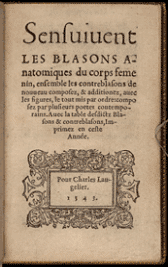
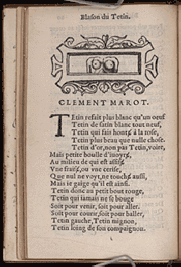
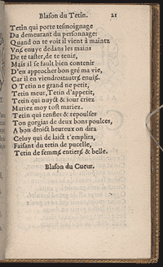
Sent from Ferrara (exile) to the French Court in 1535, originating a "contest" in writing blasons about intriguing parts of the female body. Tradition tells that the then still unknown Lyonnese poet Maurice Scève won the contest with his exquisite blason about the nostril (blason du sourcil). Marot's blason was first published in an edition of Hécatomphile (1536), and later also incorporated in the Manuscrit de Chantilly. Images from an original (1543) in which many of these blasons were gathered kept in the Gordon Library.
|
- the 4 lines in italics are missing in the editio princeps; - the 2 blue lines are missing in Janequin's song. |
translation: Portrait of a nice tit
O tit wellmade [refait or refect, has nothing to do with plastic surgery, but with 'health', 'well fed'] whiter than an egg, tit of brand new white velvet, tit that makes the rose ashamed, tit nicer than anything in the world; hard tit, not even a tit but a small ivory ball, in the middle of which a cherry or a strawberry is sitting; that nobody can see or touch but I bet it is like that. Tit with a small red end, Tit that never moves, neither coming, nor going, neither running, nor dancing. O left tit, o little tit, always far from your companion, Tit that testifies to the other parts of the person. When one sees you, many feel a desire of touching you with their hands, of holding you; But one had better refrain from getting near, for one's life's sake, because another desire will then grow. O tit, neither small, nor large, ripe tit, tit of appetite, tit that cries day and night: "Marry me soon, do!" Tit that swells and pushes back your frill [gorget/collar/shirt – the reading 'gorgias'] well over two inches: Rightly happy is he who will fill you with milk, making a maiden's tit into a complete and beautiful woman's tit.
Blason du Laid Tétin
Following the first series of blasons praising the beauty of various parts of the female body (not necessarily in a Platonic mode!), Marot launched another contest, this time composing contreblasons, mocking less admirable and ugly parts of the female body, Marot himself contributing this poem [Also a Dutch translation by D'Heere available]. As much as the 'Ladies of the Court' were charmed by the first series, they disapproved of the second, and right they were, for it is not only licentious, but rude... And, enfin, why "blasonner" at all. Read William Shakespeare.
Tétin qui n'as rien que la peau,
Tétin flac, tétin de drapeau,
Grand'tétine, longue tétasse,
Tétin, dois-je dire: besace ?
Tétin au grand bout noir
Comme celui d'un entonnoir,
Tétin qui brimballe à tous coups,
Sans être ébranlé ne secous.
Bien se peut vanter qui te tâte
D'avoir mis la main à la pâte.
Tétin grillé, tétin pendant,
Tétin flétri, tétin rendant
Vilaine bourbe en lieu de lait,
Le Diable te fit bien si laid !
Tétin pour tripe réputé,
Tétin, ce cuidé-je, emprunté
Ou dérobé en quelque sorte
De quelque vieille chèvre morte.
Tétin propre pour en Enfer
Nourrir l'enfant de Lucifer ;
Tétin, boyau long d'une gaule,
Tétasse à jeter sur l'épaule
Pour faire – tout bien compassé –
Un chaperon du temps passé,
Quand on te voit, il vient à maints
Une envie dedans les mains
De te prendre avec des gants doubles,
Pour en donner cinq ou six couples
De soufflets sur le nez de celle
Qui te cache sous son aisselle.
Va, grand vilain tétin puant,
Tu fournirais bien en suant
De civettes et de parfum
Pour faire cent mille défunts.
Tétin de laideur dépiteuse,
Tétin dont Nature est honteuse,
Tétin, des vilains le plus brave,
Tétin dont le bout toujours bave,
Tétin fait de poix et de glu,
Bren, ma plume, n'en parlez plus !
Laissez-le là, ventre saint George,
Vous me feriez rendre ma gorge.Breast that has nothing but skin, Flabby breast, breast like a rag, Great udder, long slack dug, Breast — must I say it: satchel? Breast with a great black tip Like the end of a funnel, Breast that swings about at every turn Without being jolted or shaken. He who handles you may well boast Of having put his hand to the dough. Scorched breast, drooping breast, Withered breast, breast yielding Foul muck instead of milk, The Devil surely made you so ugly! Breast held to be mere tripe, Breast — so I reckon — borrowed Or filched somehow From some old dead goat. Breast fit to nourish in Hell The child of Lucifer; Breast, gut as long as a pole, Slack dug to sling over the shoulder To make — everything well measured — A hood of the olden time. When one sees you, many feel An itching in their hands To take hold of you with double gloves, And deal five or six pairs Of slaps on the nose of her Who hides you under her armpit. Go, great foul stinking breast, You would furnish well in sweating Enough civet and perfume To make a hundred thousand corpses. Breast of spiteful ugliness, Breast that Nature is ashamed of, Breast, the bravest of the vile, Breast whose tip forever drools, Breast made of pitch and glue, Shit, my pen, speak of it no more! Leave it there, by St George's belly, You'd make me bring up my gorge.