In the 16th (and
part of the 17th) century Marot was one of the most popular lyricists
when music is concerned. In the 18th century I can't think of any
composer bothering to turn to Marot for lyrics, and in the 19th there is
only one: Napoléon-Henri Reber (1807-1880), an exceptional composer in
more than one way. Chronologically Maurice Ravel's compositions on two
epigrams of Marot also belong to the 19th century but his music to the
next. Below a list of the compositions I was able to trace, in
alphabetical order. The sources consulted are: Graham Johnson, Richard
Stokes, A French Song Companion
(OUP) and Grove's Dictionary of Music. [and 21st century...]
On the internet I found an uptempo recitation of the "petite épitre au
Roy", put to music...very nice: just
follow this link
(opens new window).
Jean Binet
(1893-1960) born in Geneva
1928: Six
mélodies
(to texts of Marot): no. 1. La plus belle des trois sera no.
2. Puisque de vous je n’ai autre visage no. 3. J'aime le cœur de
ma mie no. 4. J'ai trouvé moyen et loisir no. 5. Vous perdez
temps de me dire mal d'elle no. 6. Pour le jour de Noël
1938: Trois épigrammes (one of C. Marot, A
une Demoiselle malade), the others by C. d’Orléans, J. du
Bellay), 4vv, str qnt, (the French Song Companion gives as
date 1961, typo?). A Special page on this website is
devoted to this poem: Ma Mignonne
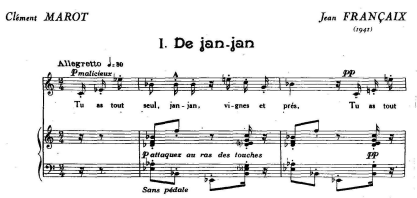
1941: Adolescence Clémentine (5 poems), vv,
pf, 1941
1. De Jehan Jehan (see on this website:
epigrams)
2. Mon coeur est tout endormy
3. D’une vieille dame fort pâle et d’un vieil gentilhomme
4. Complainte (= Adieu,
ce bel oeil & Plaisir
n'ay plus)
5. Avantnaissance (see on this website:
Avant-naissance)
1947: Chanson (Marguerite d'Alençon et de
soi-même
?), 1v, pf/gui, 1947 [to celebrate the 60th birthday of Nadia
Boulanger]
Jacques de Menasce (1905-1960)
195.?: Quatre chansons (Molière, Marot
(Epigramme de soy-mesme), Villon, D'Orléans) 1v (tenor), stringorchestra
Both songs were
dedicated to Madame Hardy-Thé, who gave their first performance at the
Salle Érard in Paris in January 1900, with Ravel accompanying her on the
piano. They were orchestrated by Maurice Delage.
18..? : a number of chansons by Marot (among
which l'Ermite - I presume: Chanson
XXXIV)
Reber (known from his Traité d'harmonie (1862)) was described by his
friend Saint-Saens as a kind of musical anachronism, bewilderd by
the way music and art was treated and developed in his own times.
According to Johnson & Stokes, his music "is worthy of reassessment.
A group of his songs, simple, yet lacking sentimentality and pathos
(the besetting sin of his period), would make an unusual and
appropriate beginning to a melodie recital." (French Song Companion,
p. 429)
1944: Trois poèmes de Ronsard et un de Clément Marot
(I. Bel Aubépin - II. Rossignol, mon mignon - III. Le Tombeau de
Ronsard - IV.
Dedans Paris, ville
jolie
(Clément Marot)), 1v (high), pf. A nice interpretation by
Christopher Goldsack with Clare Toomer at the piano:
[the odd one out:] Arthur Honegger: Trois psaumes (Pss xxxiv,
cxl, cxxxviii), 1940–41. (1v, piano) The first two are texts by Th. de Bèze, the
last one is Psalm 138 by Marot: Il faut que de tous mes esprits .
Listen to Jean-François Gardeil
https://culture.wursten.be/arthur-honegger-psalm-138/







 devoted to this poem: